

Get Free Quotes!
On some lots here, the house is the last thing you see. The driveway bends through trees, the front walk starts somewhere in the dark, and guests park by the road and guess. Carmichael Christmas stake lighting is how you light the ground between the street and the door. If that describes your place, call (916) 999-5158.
Roots come first
Most of the ground we stake lies under oaks, and an oak keeps its feeder roots near the surface. We won’t drive a stake through a root. When one meets something hard just below the surface, we shift it over and try again. Close to a trunk, where the big roots flare, we swing the line wide.
Soil under a big tree can also set up like brick, and forcing a plastic stake into it only snaps the stake. After a dry fall we may ask you to run a hose along the line the day before.
Long walks and long drives
Stake lights are holiday lights held a little above the ground on short plastic stakes, set in a row. They trace an edge: a front walk, one side of a driveway, the curve of a planting bed. Nothing attaches to the house. The stakes press into the soil by hand.
The Carmichael Creek area is the clearest case. County policy there holds the zoning to one or two homes per acre. Add the long setbacks, pastures and old groves of trees, and a driveway can cover real distance. On a lot like that we pick the line that does the most good, usually the driveway edge people walk along, plus the path to the porch. The properties toward Ancil Hoffman Park, on the river side, are the same story.
Del Dayo is a different shape. Lots there run wide more than deep, and many of the 1970s ranch homes have a circular driveway. Stakes around the inside curve of that circle draw the whole front yard in a single stroke. In Rollingwood, across the line in Fair Oaks, streets curve over rolling hills under heritage oaks, and stakes along a sloped walk help guests see where the grade changes and the steps begin.
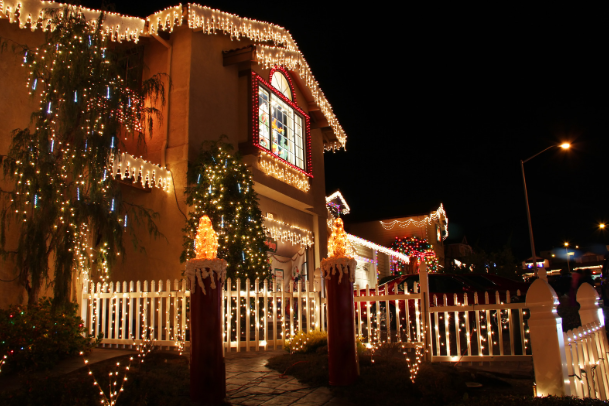
What’s buried along the walk
The edge of a walk is exactly where sprinkler heads live. It helps a great deal if you can say where they are, or run the system for a minute and send a photo of it spraying. Stakes go between heads, far enough back that a pop-up can still rise and turn.
Drip tubing hides just under the mulch, so in beds we set stakes shallow and by feel.
What stake lights pair with
Stakes lead the eye somewhere, so light something at the far end. Usually that’s a roofline across the front eave, and on a tree-heavy lot, a few wrapped trunks beside the drive. If a fence runs along your road frontage, lights on the fence line can take over where stakes would be in the way. We also keep a page for homeowners in Carmichael Creek.
Cords and power on a big lot
Power sits up by the house, and the line may end out at the road. We start from the nearest outdoor outlet and keep cords along the edge, off the part of the drive where tires roll. Wherever we can, stakes stay on the bed side of an edge so the mower gets a clear pass. Connections stay up off wet ground, and the whole run goes on a timer. Tell us about any outlet at a gate post or detached garage.
Quotes for Carmichael Christmas stake lighting, and the January pickup
No visit is needed for a quote. A photo taken from the road, looking up the drive, will usually do it, sent by text or email. Tell us about how long the walk or driveway is (“four car lengths” is a fine answer) and which edges you’d like lit. Call (916) 999-5158, or put it all on the contact page.
In January we come back, pull every stake, coil the cords and carry all of it away. If a section goes out or a stake gets kicked over before then, call (916) 999-5158.
Asked often in Stake Lighting
Will stakes hurt the roots of my oak trees?
No. If a stake hits a root we move it, and near the trunk where large roots surface we run the line wide.
What about my sprinkler heads and drip lines?
Stakes go between sprinkler heads with room for pop-ups to rise, and in mulched beds we stake shallow to stay above drip tubing.
Can you quote stake lighting without seeing the yard?
Yes. A photo from the road looking up the drive, plus a rough idea of how long the walk or driveway is, is all we need.